Pulen: A Hand-Drawn Script Font That Feels Like Your Best Craft Project
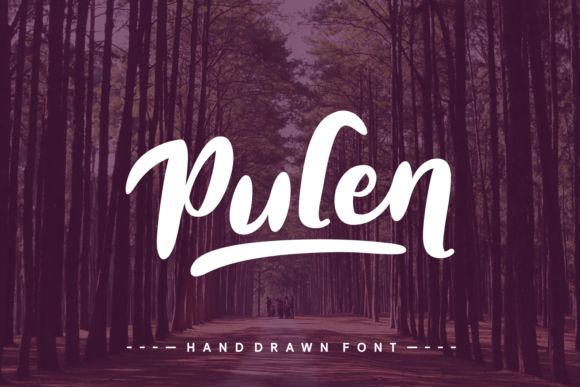
As someone who hand-labels small-batch candles, designs wedding invites for local couples, and cuts SVG stickers for boutique gift shops, I’m always hunting for a script font that does more than just look pretty—it needs to work. Pulen is that rare find: a hand-drawn font created by Rifki that balances expressive charm with real-world legibility and commercial flexibility. It’s not overly fussy, not too delicate, and never sacrifices readability for flair.
Pulen lives in the sweet spot between casual and intentional—its strokes have gentle pressure variation, subtle ink texture, and slight irregularity that reads as human-made, not algorithm-generated. There’s warmth in every curve, confidence in its ascenders and descenders, and enough spacing to keep words from collapsing on small labels or tight sticker layouts. It’s a Script Handwritten typeface that feels like it was sketched with care—not rushed, not over-polished—and that authenticity translates directly into how customers perceive your handmade goods.
Where Pulen Shines in Physical & Digital Craft Projects
I’ve used Pulen across dozens of product types—and each time, it elevated the perceived quality without demanding extra design time. On candle jars, it wraps cleanly around 2-inch round labels, especially when paired with a simple sans serif for ingredients or scent notes. For greeting cards and invitations, Pulen handles names and short phrases beautifully: “Emma & James,” “Join Us,” “Hand-Poured With Love.” Its natural rhythm makes even basic text feel considered and personal.
It works equally well on rustic farmhouse signs (cut from wood or printed on kraft paper), printable wall art for nurseries or offices, and digital planner pages where soft contrast matters. I recently used Pulen for a set of seasonal tea towel patterns—its slightly rounded terminals softened the overall look while keeping letterforms distinct at 18pt. For wedding stationery, it’s ideal for welcome boards, menu cards, and envelope addressing—especially when printed on textured cotton paper. And yes, it holds up on mugs and tote bags when scaled appropriately: I avoid going smaller than 24pt for screen-printed text, but at 36pt+, Pulen’s character really sings.
Practical Readability Tips for Makers
Here’s what I’ve learned after testing Pulen on Cricut, Silhouette, and direct print workflows:
- For cutting machines: Use the OTF version—it imports cleanly and maintains stroke integrity better than TTF on complex cuts.
- For small stickers (under 1.5 inches): Stick to uppercase single words (“YES,” “LOVE,” “GIFT”) or very short phrases—avoid lowercase “g” or “y” at tiny sizes, as their descenders can blur.
- For printed product labels: Pulen pairs best with high-contrast backgrounds (white label + dark ink, or kraft label + deep navy). Avoid light gray text—it loses definition.
- In mockups: Preview at actual size before finalizing. Pulen’s charm comes through most clearly at 20–48pt, so zoom out and check how it renders on mobile previews and Etsy thumbnails.
Smart Pairings That Keep Your Brand Cohesive
Pulen thrives when balanced—not buried. As a display font, it’s meant to lead, not carry long paragraphs. I almost always pair it with a clean, neutral companion: a friendly sans serif like Montserrat or Poppins for body text, pricing, or care instructions. For packaging or boutique tags, try pairing Pulen with a quiet serif like Lora or Merriweather—just enough contrast to guide the eye without competing.
What makes this pairing work is intention: Pulen sets the emotional tone (warm, personal, artisanal), while the secondary font grounds it in clarity and function. That balance builds brand identity faster than any logo alone—customers begin to recognize your style across stickers, cards, and digital downloads because the typography feels consistently thoughtful.
What’s Included & What You Can Do Commercially
Pulen ships as a complete Fonts package with OpenType features—including standard ligatures and stylistic alternates. While it doesn’t include extensive multilingual glyphs, it covers full Latin-1 support (accents for French, Spanish, German, etc.), which covers most craft markets I serve. The file formats are straightforward: OTF and TTF, ready for Canva, Adobe Suite, Cricut Design Space, and Silhouette Studio.
Crucially, Pulen includes a commercial license—meaning you can use it to create and sell physical products (like printed greeting cards or embroidered patches), digital downloads (planner pages, SVG bundles, Canva templates), and merchandise (totes, mugs, apparel). You can also use it in client work—say, designing a custom invitation suite for a local bakery. Just remember: you’re licensing usage rights, not redistribution rights. Don’t resell the font files themselves or include them unembedded in editable template files.
A Font That Grows With Your Shop
What I appreciate most about Pulen isn’t just how it looks—it’s how reliably it adapts. It’s equally at home on a holiday cookie box label and a minimalist baby shower invite. It reads as joyful on a birthday SVG cut file and serene on a botanical-themed printable. Because it’s hand-drawn—not digitized calligraphy or AI-generated—it carries subtle imperfections that make your products feel human-made, not mass-produced.
If you're building a shop where every detail signals care—from the knot on your twine tag to the kerning on your thank-you card—Pulen supports that intention without extra effort. It’s not a trend-chasing script font. It’s a quietly confident, commercially smart, and deeply usable typeface that belongs in your core design assets—not just your “fun fonts” folder.